
Quick Answer
The most important places inside Masjid al-Nabawi in Madinah are Rawdah Mubarak (Riyad ul Jannah), the sacred area between the Prophet’s pulpit and house described as a garden from Paradise; Roda e Rasool, where Prophet Muhammad (PBUH) is buried alongside Abu Bakr (RA) and Umar (RA); Mihrab al-Nabawi, where the Prophet (PBUH) led prayers; Minbar al-Nabawi, the Prophet’s original pulpit; and the iconic Green Dome above the Sacred Chamber. Visiting the Rawdah requires a permit through the official Nusuk app; use the time and gate shown on your permit because access arrangements can change.
Official access information checked September 22, 2026. Rawdah arrangements can change, so use the live permit details in the official Nusuk app.
Masjid-e-Nabawi is large, and first-time visitors may find it challenging to orient themselves. These markers help:
- Green Dome: Landmark for locating Roda e Rasool
- Bab-e-Jibrael: Entry point near Rawdah Gate
- Bab-us-Salam: Gate used for salutation and Rawdah entry
- Ottoman Prayer Hall: Area with columns and historic spots
- Green Carpet Sections: Mark Rawdah and Roda e Rasool vicinity
Quick Facts
- Full name: Al-Masjid an-Nabawi (المسجد النبوي)
- Location: Madinah al-Munawwarah, Saudi Arabia
- Founded: 622 CE (1 AH) by Prophet Muhammad (PBUH)
- Capacity: More than 1 million worshippers across the full complex
- Total area: Around 20.26 acres
- Prayer reward: One prayer equals 1,000 prayers in other mosques except Masjid al-Haram
- Rawdah virtue: Described as a garden from Paradise
- Green Dome: Covers the resting place of Prophet Muhammad (PBUH), Abu Bakr (RA), and Umar (RA)
- Minarets: 10 minarets, each around 104 metres tall
- Rawdah permit: Required through the official Nusuk app
- Repeat visits: Check current availability in Nusuk; the official Haramain Nusuk page describes an Instant Path option
- Visit duration: Follow the time window shown on your Nusuk permit
- Men’s visiting windows: Check Nusuk; the Saudi Press Agency notice lists separate men’s periods
- Women’s visiting windows: Check Nusuk; the Saudi Press Agency notice lists separate women’s periods
- Children: Check the current age and permit eligibility shown in Nusuk
- Second holiest mosque in Islam: Yes, after Masjid al-Haram in Makkah
The Spiritual Significance of Masjid al-Nabawi
Masjid al-Nabawi is the second-holiest mosque in Islam, built by the Prophet Muhammad (PBUH) himself in 622 CE following the Hijra from Makkah to Madinah. What began as a simple open-air structure of palm trunks and mud-brick walls measuring approximately 30 by 35 meters has expanded over fourteen centuries into a complex spanning over 20 acres, serving more than one million worshippers simultaneously.
Every prayer offered inside Masjid al-Nabawi is equivalent to one thousand prayers offered elsewhere, with the sole exception of Masjid al-Haram in Makkah. The Prophet (PBUH) said: “One prayer in my mosque is better than a thousand prayers in any other mosque, except Al-Masjid Al-Haram.” (Sahih al-Bukhari)
For pilgrims performing Hajj and Umrah, visiting Madinah and praying at Masjid al-Nabawi is among the most spiritually profound experiences of their journey. Understanding the significance of each location inside the mosque transforms a physical visit into a deeply conscious act of faith.
This guide covers every important location inside Masjid al-Nabawi, the historical and spiritual significance of each, the 2026 rules for accessing the Rawdah, and practical guidance to help pilgrims make the most of every moment inside the Prophet’s Mosque.
1. Rawdah Mubarak (Riyad ul Jannah)
The Garden of Paradise
The Rawdah Mubarak, or Riyad ul Jannah (روضة مباركة), is the most spiritually significant location inside Masjid al-Nabawi. The Prophet Muhammad (PBUH) said:
“Between my house and my pulpit lies a garden from the gardens of Paradise, and my pulpit is upon my fountain (Hawd).” (Sahih al-Bukhari)
This small, rectangular area extends from the Prophet’s Sacred Chamber (where his tomb is located) westward to the Minbar (pulpit). It is approximately 22 by 15 meters in size and is covered with a distinctive light green floral carpet, easily distinguishable from the red carpet covering the rest of Masjid al-Nabawi. This green carpet serves as the visual identifier of the Rawdah’s boundaries for every pilgrim.
The supplications made inside the Rawdah are considered especially likely to be accepted. Scholars across generations have described it as one of the few locations on earth where the veil between the suppliant and divine acceptance is at its thinnest.
The Rawdah also contains several historically significant pillars (Ustuwanat) that mark locations of specific events from the Prophet’s life. These are detailed in the pillars section below.
Current access rules: Entry requires a permit through the official Nusuk app. Book before arrival, then follow the date, time and gate displayed on your permit. The Saudi Press Agency confirms separate visiting periods for men and women.
2. Roda e Rasool (The Sacred Chamber / Hujra Sharifa)
The Resting Place of the Prophet (PBUH)
The Roda e Rasool (also written as Rawdah Rasool or Hujra Sharifa) refers specifically to the Sacred Chamber that contains the grave of the Prophet Muhammad (PBUH). This chamber is located in the south-eastern corner of the original Ottoman prayer hall, the oldest part of the current mosque complex.
The grave of Prophet Muhammad (PBUH) is not visible from any external or internal point outside the grilled enclosure. The small chamber containing the grave is approximately 10 feet by 12 feet, surrounded by at least two further walls and a fabric shroud. The chamber also contains the graves of Abu Bakr as-Siddiq (RA), the first Caliph and closest companion of the Prophet, and Umar ibn al-Khattab (RA), the second Caliph.
A fourth burial space within the chamber is believed by many scholars to be reserved for the Prophet Isa (Jesus, peace be upon him), to be buried there upon his return, based on hadith traditions.
Viewing the graves: Three small viewing openings are located within the grilled enclosure. The largest opening on the left faces the grave of the Prophet (PBUH); the middle opening faces the grave of Abu Bakr (RA); and the opening on the right faces the grave of Umar (RA). Pilgrims offering salam at the grave should face the grilled enclosure and offer salutation: “Assalamu Alaika Ayyuhan Nabiyyu wa Rahmatullahi wa Barakatuh.”
The Prophet (PBUH) said: “Whoever calls for blessings on me in any place, his every need in this world and in the hereafter is fulfilled, and on the Day of Qiyamah I shall be his witness and intercessor.” (Bayhaqi)
3. Al-Rawdah al-Sharifah (Combined Sacred Area)
The term “Al-Rawdah al-Sharifah” (الروضة الشريفة — the Noble Garden) is used to refer to the area encompassing both the Rawdah Mubarak (the garden between the pulpit and the house) and the Sacred Chamber. It represents the spiritual core of Masjid al-Nabawi and the primary focus of every pilgrim’s visit to Madinah.
4. Mihrab al-Nabawi
Where the Prophet (PBUH) Led Prayers
The Mihrab al-Nabawi (محراب النبوي) marks the exact spot where the Prophet Muhammad (PBUH) stood and led congregational prayers inside the mosque. According to Imam Malik, praying at the Mihrab al-Nabawi is the best place to pray salah inside Masjid al-Nabawi, and for this reason, a prayer niche was formally installed there.
The current Mihrab al-Nabawi is richly decorated with patterns and gold-plated calligraphic inscriptions. It was not present during the time of the Prophet (PBUH) or the Rightly Guided Caliphs, but was built by Umar ibn Abd al-Aziz (Umar II) during the caliphate of Walid ibn Abd al-Malik, when Umar II was the governor of Madinah.
The Mihrab al-Nabawi is distinct from the Mihrab Uthmani (the Uthman prayer niche), where the Imams of Masjid al-Nabawi have historically led the congregation in prayer. Until recently, the Imams led prayers from the Mihrab Uthmani rather than the Mihrab al-Nabawi.
5. Minbar al-Nabawi (The Prophet’s Pulpit)
The Original Pulpit and Its Heavenly Promise
The Minbar al-Nabawi (منبر النبوي) is the pulpit from which the Prophet Muhammad (PBUH) delivered his Friday khutbahs (sermons) and important addresses to the Muslim community. The original minbar was a simple wooden structure of three steps. The Prophet (PBUH) had previously delivered sermons leaning against a palm tree trunk; when the minbar was constructed, the tree trunk reportedly wept audibly, a miracle witnessed by the companions.
The Prophet (PBUH) said: “My pulpit is on one of the hills of Paradise.” This narration establishes the minbar’s spiritual significance as part of the Rawdah’s heavenly description.
The current minbar is not the original wooden minbar. The original was burned in a fire in 654 AH. Subsequent caliphs and rulers of Madinah commissioned replacement minbars, and the current marble-and-wood construction reflects later Islamic architectural tradition.
The Minbar forms the western boundary of the Rawdah Mubarak.
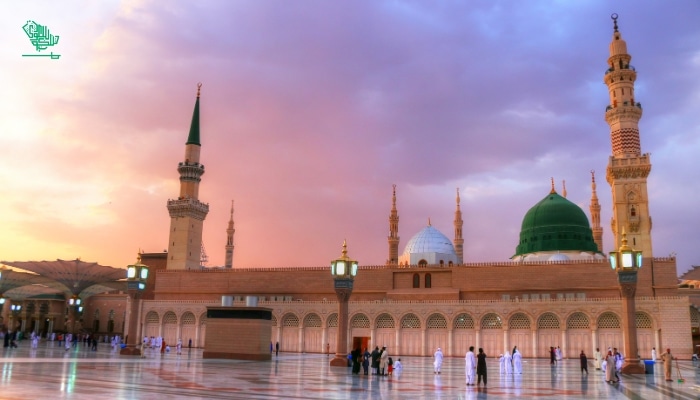
6. The Green Dome (Al-Qubba al-Khadra)
The Most Recognizable Symbol of Madinah
The Green Dome (القبة الخضراء — Al-Qubba al-Khadra) is the iconic emerald-green dome that rises above the Sacred Chamber, which contains the grave of the Prophet (PBUH). It is the most visually recognized symbol of Masjid al-Nabawi and of Madinah itself, and its image appears on the Saudi ten-riyal banknote.
The dome was not part of the original mosque’s construction. It was built in 678 AH (approximately 1279 CE) during the Mamluk period as a wooden structure. It was later rebuilt in stone, and the distinctive green color was applied during the Ottoman renovation of 1837 CE under Sultan Mahmud II.
The current structure has remained substantially unchanged since the Ottoman renovation. The dome rises over the Sacred Chamber, where the graves of the Prophet (PBUH), Abu Bakr (RA), and Umar (RA) are located. The dome is not directly accessible to visitors; its significance is visual and symbolic, reminding pilgrims of the nearness of the Prophet’s blessed resting place.
Viewing the Green Dome: The dome is visible from outside the mosque from multiple angles around the complex and from nearby buildings. The internal courtyard areas provide the closest views from within the mosque grounds. No special permit is required to view the dome.
People Also Ask: What Is the Rawdah in Masjid Nabawi?
The Rawdah (also written Rawdah Mubarak or Riyad ul Jannah) is the small area inside Masjid al-Nabawi described by the Prophet Muhammad (PBUH) as a garden from the gardens of Paradise. It extends from the eastern boundary of the Prophet’s Sacred Chamber tomb enclosure westward to the Minbar (pulpit), covering an area of approximately 22 meters by 15 meters. It is distinguished by its distinctive light-green floral carpet, which contrasts with the red carpet covering the rest of the mosque. Supplications made in the Rawdah are considered especially significant, and millions of pilgrims seek to pray nawafil (voluntary prayers) within it every year.
7. The Six Sacred Pillars (Ustuwanat) of the Rawdah
The six sacred pillars inside the Rawdah area stand on the exact locations where the original palm-tree trunks supported the roof of the first mosque built by the Prophet (PBUH) and his companions. These pillars are distinct from all other columns in the current Masjid al-Nabawi and hold profound historical and spiritual significance. Two additional pillars are located inside the Sacred Chamber itself.
Ustuwanah al-Hannana (The Weeping Pillar)
Also known as Ustuwanah al-Mukhallaqah (the Perfumed Pillar), this is one of the most emotionally significant spots in the entire mosque. It marks the location of the palm tree trunk against which the Prophet (PBUH) used to lean while delivering his sermons before the minbar was constructed. When the minbar was built and the Prophet (PBUH) began using it, the companions heard the palm trunk weep audibly with longing for the Prophet. The Prophet (PBUH) descended and embraced it, and the weeping ceased.
Ustuwanah Aisha (Pillar of Aisha)
Also known as Ustuwanah al-Qur’ah (Pillar of Casting Lots) or Ustuwanah al-Muhajireen (Pillar of the Emigrants). Aisha (RA) reported that the Prophet (PBUH) told her that this spot is so blessed that if people knew about it, they would cast lots to pray here. She kept the exact location secret during the Prophet’s lifetime. Scholars have historically identified this pillar with the position described in the hadith, and it is considered one of the most blessed spots within the Rawdah.
Ustuwanah al-Tawbah (Pillar of Repentance)
Also known as Ustuwanah Abu Lubabah (Pillar of Abu Lubabah). This marks the location where Abu Lubabah ibn Abd al-Mundhir (RA) tied himself in repentance after inadvertently betraying the Prophet’s plans. He tied himself to this pillar and refused to untie himself until the Prophet (PBUH) untied him by hand, following the revelation of the Quranic verse accepting his repentance (Surah al-Anfal 8:27).
Ustuwanah al-Wufud (Pillar of the Delegations)
This pillar marks where the Prophet (PBUH) used to sit when receiving delegations from Arab tribes. It was also known as Majlis al-Qalawah (the seat of the nobles), as the chieftains and learned Sahabah would assemble there. Historically, it was located at the edge of the original mosque’s shaded area.
Ustuwanah al-Tahajjud (Pillar of Night Prayer)
This marks the approximate location where the Prophet (PBUH) used to stand for his voluntary night prayers (Tahajjud). It is located toward the northern side of the Rawdah.
Ustuwanah al-Sareer (Pillar of the Bed)
Located to the south of the guard column (Ustuwanah al-Haras), this marks the spot where a mat of dry date leaves was placed along the southern wall during the Prophet’s time. He would sometimes rest here between prayers.
8. Bab al-Salam (Gate of Peace)
Bab al-Salam (باب السلام — Gate of Peace) is historically the most significant entrance gate to Masjid al-Nabawi. Pilgrims are traditionally encouraged to enter the mosque through this gate, offering salutations and prayers as they step inside. The tradition of entering mosques with the right foot and reciting the appropriate dua is particularly emphasized at this gate.
Bab al-Salam was one of the original gates of the Prophet’s Mosque. Today, it serves as a primary entry point for pilgrims heading toward the Rawdah. For men visiting the Rawdah, Bab al-Salam (Gate 1) is a commonly used entry point, though gate assignments may vary depending on individual Nusuk permits.
9. Bab Jibril (Gate of Gabriel)
Bab Jibril (باب جبريل) is named for the archangel Jibril (Gabriel, peace be upon him), who is said to have entered the mosque through this gate when visiting the Prophet (PBUH) with revelation. It is one of the historically named original gates of the mosque and is located on the complex’s eastern side.
10. Bab al-Nisa (Gate of the Women)
Bab al-Nisa (باب النساء — Gate of the Women) is the gate specifically designated for women entering Masjid al-Nabawi. The Prophet (PBUH) is reported to have said: “We should leave this gate for the women.” Since that time, the tradition of a dedicated women’s entrance has been maintained. Women typically use separate entrances for the Rawdah visit as well, with their Nusuk permit specifying the relevant gate.
11. Suffah Platform (Ashab al-Suffah)
The Suffah was a raised platform or shaded area at the back of the original mosque where the Ashab al-Suffah (the People of the Bench) resided. These were the Companions of the Prophet (PBUH) who had no homes in Madinah and lived at the mosque, dedicating themselves entirely to worship, learning, and receiving knowledge directly from the Prophet. The Suffah produced some of the greatest hadith narrators in Islamic history, including Abu Huraira (RA).
The approximate location of the original Suffah is within the current Rawdah area boundaries, near the back pillars at the boundary of the green carpet. The Suffah’s location after the Qibla shift to Makkah would have been in this area.
12. Mihrab Uthmani
The Mihrab Uthmani (محراب عثماني) is the prayer niche installed during the caliphate of Uthman ibn Affan (RA). For most of Islamic history, the Imams of Masjid al-Nabawi led congregational prayers from this mihrab rather than the Mihrab al-Nabawi. The Mihrab Uthmani is located in the current main prayer hall.
13. Ottoman Prayer Hall and Courtyards
The Ottoman Prayer Hall is the oldest surviving structure in the current Masjid al-Nabawi complex, containing the Sacred Chamber and the Rawdah. Two Ottoman Courtyards adjoin the prayer hall, shaded by 12 large retractable umbrella structures that open and close with temperature changes. These courtyards provide overflow prayer space during peak times and are among the most pleasant areas to sit and make dhikr and dua during the cooler parts of the day.
14. Jannatul Baqi Cemetery
While technically outside the mosque building itself, Jannatul Baqi (جنة البقيع — the Garden of Baqi) is immediately adjacent to the eastern side of Masjid al-Nabawi and is the most historically significant Islamic cemetery in the world.
Many of the closest companions and family members of the Prophet (PBUH) are buried here, including:
- Uthman ibn Affan (RA), the third Caliph
- Hassan ibn Ali (RA), grandson of the Prophet
- Fatimah al-Zahraa (RA), daughter of the Prophet (according to some scholars)
- Many of the Prophet’s wives (Mothers of the Believers)
- Numerous Sahabah (companions)
Visiting Jannatul Baqi and offering salutations and prayers for its occupants is a sunnah of the Prophet (PBUH). He regularly visited this cemetery and taught the companions the specific dua for visiting graves.
Visiting hours: Jannatul Baqi is open to male visitors after morning (Fajr) and evening (Asr) prayers for specific time windows. Women are not permitted inside the cemetery itself but may offer salutations from the gate.
15. The Minarets of Masjid al-Nabawi
Masjid al-Nabawi is crowned with 10 minarets, each reaching 104 meters (341 feet) in height. These minarets, added during various expansions and renovations, are distinctly different in design from those of Masjid al-Haram in Makkah. The original mosque had no minaret; the adhan was called from the roof. The tradition of minarets developed progressively through the Umayyad and Abbasid periods.
People Also Ask: How Do I Book a Rawdah Permit in 2026?
Book a Rawdah permit through the official Nusuk app. Availability, visit time and entry gate appear in the permit.
Step-by-step guide:
- Download the Nusuk app from the Apple App Store or Google Play Store
- Register using your Umrah visa number and passport number. Do this as soon as your visa is issued, not after arriving in Madinah
- Open the app home screen and scroll down to “Holy Mosque Services.”
- Tap “Booking of Permit for Noble Rawdah (Men)” or “Noble Rawdah (Women)” — these are completely separate services with different time slots
- Check the box next to your name and add any family members (Companions) linked to your account
- Select an available date and time slot (green-highlighted). Slots fill within seconds of opening. Check at the top and bottom of each hour and try again if no slots appear
- Confirm and accept the terms and conditions
- Your permit appears immediately with a QR code. Screenshot it and save it; the signal inside the mosque courtyard can be weak
- On the day, arrive at the designated entry gate at least 20 to 30 minutes before your slot
Gate information (general guide for 2026):
- Men: typically Bilal Gate (Gate 25) or Bab al-Salam (Gate 1); confirm on your individual permit
- Women: typically Gate 37 area (near Pullman hotel side); confirm on your individual permit
Frequency: Check the current eligibility shown in Nusuk rather than relying on a fixed interval. The official Haramain Nusuk page describes an Instant Path service, but availability depends on the app.
Important 2026 update: Since 2025, the Nusuk permit system has been mandatory. Walk-in access to the Rawdah without a permit is not permitted. The Nusuk help desk in the mosque courtyard can assist elderly pilgrims with manual arrangements in rare cases.
People Also Ask: What Is the Difference Between Rawdah and Riyad ul Jannah?
They refer to the same place. Rawdah Mubarak, Riyad ul Jannah, Rawdah Sharifah, and Rawdah Rasool (in a general sense) all refer to the same sacred area within Masjid al-Nabawi, between the Prophet’s house and his pulpit. Different terms are used in different languages and traditions: “Rawdah” is the Arabic term for the area, while “Riyad ul Jannah” (also spelled Riyadhul Jannah or Riaz ul Jannah) is the full descriptive name meaning “Garden of Paradise.”
Technically, “Roda e Rasool” and “Rawdah Rasool” can also refer specifically to the Sacred Chamber containing the tomb, depending on context. In common pilgrim usage, however, when someone says “I visited the Rawdah,” they mean they prayed in the green-carpeted garden area.
People Also Ask: Can Women Visit the Rawdah in Masjid Nabawi?
Yes. Women can visit the Rawdah but must book a separate permit through the Nusuk app using the “Noble Rawdah (Women)” service, which has entirely different time slots from men’s visiting hours.
Women’s visiting hours (general guide):
- After Fajr prayer until mid-morning
- After Isha prayer until approximately 2am
Women enter through separate designated gates (typically Gate 37 area or as specified on the individual permit) with dedicated security checks. Women are strongly advised to arrive at the gate at the start of their time slot, as the available time is limited.
For children, check the current age and permit eligibility in Nusuk before travel. The official sources reviewed do not support a universal age rule for every visiting window.
People Also Ask: What Is the Green Dome in Madinah?
The Green Dome (Al-Qubba al-Khadra) is the iconic emerald-green dome above the Sacred Chamber of Masjid al-Nabawi in Madinah, marking the location of the grave of Prophet Muhammad (PBUH). It is the most recognizable symbol of the Prophet’s Mosque and of Madinah itself.
The dome was first built as a wooden structure in 678 AH (approximately 1279 CE) during the Mamluk period. It was rebuilt in stone in subsequent centuries and was painted its distinctive green color during Ottoman renovations in 1837 CE under Sultan Mahmud II.
The graves of Abu Bakr as-Siddiq (RA) and Umar ibn al-Khattab (RA) are also located beneath the same dome structure. The dome itself is not directly accessible to visitors; it is viewed from the mosque courtyards and from the surrounding streets and buildings.
People Also Ask: How Many Times Can I Visit the Rawdah?
There is no fixed interval you should rely on without checking the app. Nusuk shows your current eligibility and available slots.
The Instant Path service may show additional access when available. Follow the live instructions in Nusuk; do not plan around unofficial reports of fixed release times.
People Also Ask: Is Masjid al-Nabawi the Second Holiest Mosque in Islam?
Yes. Masjid al-Nabawi in Madinah is the second-holiest mosque in Islam, after Masjid al-Haram in Makkah (which contains the Kaaba). The third holiest is Masjid al-Aqsa in Jerusalem.
Prayer in Masjid al-Nabawi is equivalent to 1,000 prayers elsewhere, while prayer in Masjid al-Haram is equivalent to 100,000 prayers. The Rawdah area within Masjid al-Nabawi has an additional specific virtue, as the Prophet (PBUH) described it as a garden of Paradise.
Practical Visitor Guide: Masjid al-Nabawi in 2026
Opening Hours
Masjid al-Nabawi is open 24 hours a day. The mosque admits worshippers continuously. The Rawdah has specific visiting windows managed through the Nusuk permit system.
Dress Code
- Men: Clean, modest clothing. White thobes are commonly worn. Ensure shoulders and legs are covered. Shoes are removed and stored in provided bags or left outside.
- Women: Full abaya or equivalent modest covering; hijab required. Women must be appropriately covered before entering all areas of the mosque.
What to Bring
- Nusuk permit QR code (screenshot and save before entering; signal can be unreliable inside the courtyard)
- Charged phone (security checks your digital permit)
- Small prayer mat if preferred (the mosque provides carpet; bringing your own is optional)
- No large bags; the Rawdah queue does not accommodate large luggage
What Not to Bring
- Large backpacks or luggage
- Food or drinks inside the prayer hall
- Any item that could cause disturbance
Best Times to Visit (Outside Rawdah Permit)
- Early mornings (2 am to before Fajr) are among the quietest periods for general prayer inside the mosque
- Avoid the 15 to 20 minutes immediately before each of the five daily prayers when the mosque fills to capacity
- The hottest months (June to August, when temperatures exceed 43°C) make outdoor courtyard time uncomfortable; plan indoor activities during these hours
People Also Search: Related Masjid al-Nabawi Topics
Masjid Nabawi history: Built by the Prophet (PBUH) in 622 CE on land he purchased from two orphan boys (Sahl and Suhayl, sons of Amr). The original mosque measured approximately 30 by 35 meters. It has been expanded and renovated under every major Islamic dynasty since, reaching its current vast scale under the Saudi expansions of the 20th and 21st centuries.
Masjid Nabawi capacity: The current complex accommodates over 1 million worshippers simultaneously in the main prayer hall, extensions, and the outdoor courtyard. During peak Hajj and Ramadan seasons, crowd management and timed access systems are in place.
Masjid Nabawi map: The General Presidency of the Two Holy Mosques provides official maps at the mosque’s welcome centers. The Nusuk app includes a navigation feature for pilgrims. Key landmarks (Rawdah entrance gates, Jannatul Baqi entrance, wudu areas, and medical facilities) are signposted in Arabic and English throughout the complex.
Prayer reward at Masjid Nabawi: 1,000 prayers (equivalent to 1,000 prayers at any other mosque, except Masjid al-Haram, which is 100,000). The Rawdah carries additional specific virtue.
Ghusl (ritual bath) before visiting Masjid Nabawi: While not obligatory, performing ghusl, wearing clean clothes, and applying non-alcoholic fragrance (attir) before visiting is a recommended sunnah practice.
What to recite when visiting the Prophet’s grave: “Assalamu Alaika Ayyuhan Nabiyyu wa Rahmatullahi wa Barakatuh, Assalamu Alaika Ya Rasulallah.” Scholars recommend not raising one’s voice and to greet as one would a living guest, facing the grilled enclosure.
Visiting Madinah before or after Makkah: Both orders are practiced. Many scholars recommend visiting Madinah first to receive the spiritual blessing of the Prophet’s city, then proceeding to Makkah for Umrah or Hajj. Others prefer Madinah after Makkah. There is no single obligatory order.
Quba Mosque near Masjid Nabawi: Masjid Quba is the first mosque in Islamic history, built by the Prophet (PBUH) upon his arrival in Madinah before reaching the city center. Two rakats of voluntary prayer at Masjid Quba carry a reward equivalent to one Umrah, according to hadith. It is approximately 3 km from Masjid al-Nabawi.
Summary: All Important Places Inside Masjid al-Nabawi
| Location | Significance | Permit Required |
|---|---|---|
| Rawdah Mubarak (Riyad ul Jannah) | Garden of Paradise; prayers here are especially significant | Yes (Nusuk app) |
| Roda e Rasool (Sacred Chamber) | Tomb of Prophet (PBUH), Abu Bakr (RA), Umar (RA) | No (view through grille) |
| Mihrab al-Nabawi | Access via the Rawdah permit | No |
| Minbar al-Nabawi | Cemetery of companions and family of the Prophet (PBUH) | No |
| Green Dome | Iconic dome over Sacred Chamber | No (view from courtyard) |
| Six Sacred Pillars (Ustuwanat) | 104-meter minarets; Ottoman and Saudi renovations | Access via Rawdah permit |
| Bab al-Salam | Original and spiritually named entry gate | No |
| Bab Jibril | Gate named for archangel Jibril | No |
| Bab al-Nisa | Women’s dedicated gate | No |
| Suffah Platform | Where Ashab al-Suffah lived and learned | No |
| Mihrab Uthmani | Uthman-era prayer niche; historically used by Imams | No |
| Ottoman Prayer Hall | Oldest surviving prayer section | No |
| Jannatul Baqi Cemetery | Mark the original palm-trunk supports and historic events | No (gate visit) |
| 10 Minarets | 104-metre minarets; Ottoman and Saudi renovations | No |
Frequently Asked Questions
The Rawdah Mubarak (Riyad ul Jannah) is the single most important location, described by the Prophet (PBUH) as a garden of Paradise. After it comes the Roda e Rasool (Sacred Chamber) to offer salam to the Prophet. The Mihrab al-Nabawi, Minbar al-Nabawi, Green Dome, and the six sacred pillars complete the essential spiritual itinerary inside the mosque.
Yes. A permit through the official Nusuk app is required to enter the Rawdah. Book before arriving, then follow the date, time and gate shown on your permit.
Riyad ul Jannah (Gardens of Paradise) is the sacred area inside Masjid al-Nabawi described by the Prophet Muhammad (PBUH) as a garden from the gardens of Paradise. It is identified by its green carpet and extends from the Prophet’s Sacred Chamber westward to the Minbar. It is also known as Rawdah Mubarak or Rawdah Sharifah.
The Prophet Muhammad (PBUH), Abu Bakr as-Siddiq (RA) — the first Caliph and closest companion — and Umar ibn al-Khattab (RA) — the second Caliph — are all buried in the Sacred Chamber beneath the Green Dome. A fourth space in the chamber is believed by many scholars to be reserved for the Prophet Isa (Jesus, peace be upon him).
One prayer in Masjid al-Nabawi is equivalent to 1,000 prayers in any other mosque, except Masjid al-Haram in Makkah (which is 100,000). The Rawdah area within Masjid al-Nabawi holds additional spiritual virtue, as explicitly described in authentic hadith.
The six sacred pillars mark the exact locations of the original palm-tree trunks that supported the first mosque’s roof. The most significant are: Ustuwanah al-Hannana (Weeping Pillar), Ustuwanah Aisha (Pillar of Aisha), Ustuwanah al-Tawbah (Pillar of Repentance/Abu Lubabah), Ustuwanah al-Wufud (Pillar of Delegations), Ustuwanah al-Tahajjud (Pillar of Night Prayer), and Ustuwanah al-Sareer (Pillar of the Bed).
No. Jannatul Baqi is a separate cemetery immediately adjacent to the eastern side of Masjid al-Nabawi. It is the most historically significant Islamic cemetery and contains the graves of many companions and family members of the Prophet (PBUH). It is open to male visitors after Fajr and Asr prayers.
Conclusion: Making Every Moment Count at Masjid al-Nabawi
Masjid al-Nabawi is not simply a mosque to visit; it is the mosque built by the hands of the Prophet Muhammad (PBUH) himself, the location of his earthly farewell, and the place where his blessed grave rests in the earth. Every step inside it carries the weight of 1,400 years of Muslim devotion and the living presence of the Prophet’s legacy.
Book your Rawdah permit through the Nusuk app before leaving home. Learn the supplications and salutations before you arrive so your limited time inside the Rawdah is spent entirely in worship rather than remembering what to say. Arrive early at the designated gate. Offer your salam at the Prophet’s grave with full presence of heart.
The Prophet (PBUH) said: “Whoever performs his Hajj in Makkah, then comes to Madinah with the sole aim of visiting me in my Masjid, for him shall be written the rewards of two accepted Hajj.” (Daylami)
May Allah grant every Muslim the blessing of visiting His beloved Prophet’s mosque, accept all prayers offered within it, and fill every heart that stands before that blessed chamber with light, peace, and love for the Prophet (PBUH). Ameen.
Related Saudi Scoop guides:
- Booking Makkah Hotels During Hajj Season 2026 for accommodation guidance
- Haramain Train Ticket Prices 2026 for traveling between Madinah and Makkah
- How to Visit the Kiswa Factory Makkah 2026 for the Makkah portion of your journey
- Umrah Season 1448 AH Calendar for Umrah season dates
DISCLAIMER: Islamic historical and spiritual information is compiled from classical hadith collections and scholarly sources. Saudi Scoop is not affiliated with the General Presidency of the Two Holy Mosques or the Nusuk platform. Always verify current visiting rules and permit requirements via the official Nusuk app before travel.
Faisal Malik is an accomplished author and the Chief Editor at Saudi Scoop. With a passion for delivering insightful and engaging content, he leads the editorial team, covering diverse topics that resonate with readers. His expertise in journalism and storytelling ensures high-quality, well-researched articles that inform and inspire.